
From Question to Cart: The AI Shopping Journey
For twenty years, buying anything significant meant the same ritual: open Google, scan results, click through to multiple sites, open new tabs for reviews, compare prices in yet more tabs, maybe check Reddit for "real" opinions, then finally return to wherever offered the best combination of trust and convenience. A simple jacket purchase might touch fifteen different pages across an hour of fragmented research. Each click represented a small decision. Each tab held a piece of the puzzle the buyer had to assemble themselves.
That process is collapsing into something radically different.
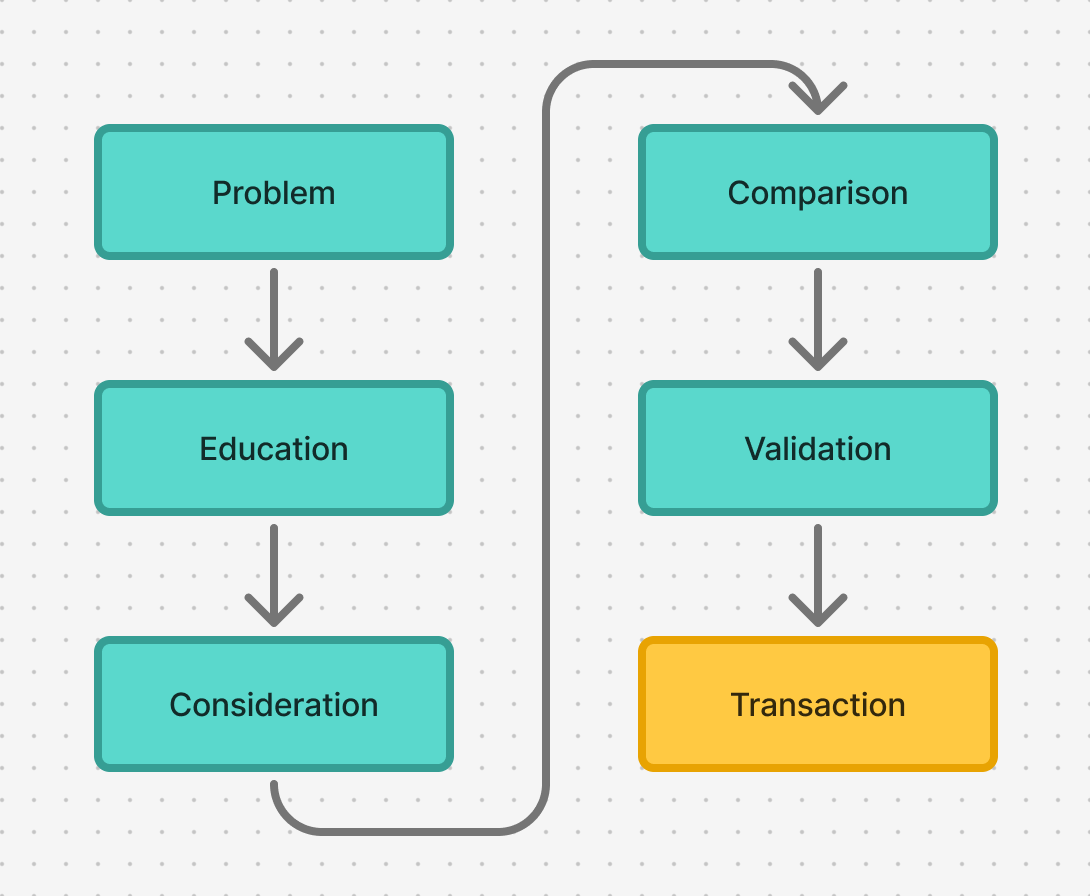
The person planning a January trip to New York no longer opens ten browser tabs. They type a single question into ChatGPT or Perplexity: "I'm going to New York in January. What kind of clothes should I pack or buy?" What follows isn't a list of links. It's a conversation that compresses the entire research phase - problem definition, category education, brand discovery, product comparison, trust validation into minutes of natural dialogue.
This isn't just a new interface layered on top of the same process. It's a restructuring of how purchase decisions actually form. The research that used to happen across your website, your competitors' sites, review platforms, and comparison tools now happens in a single conversation that may never touch any of those properties.
Most brands are optimizing for a customer journey that no longer exists. They're measuring touchpoints that never happen, running campaigns for consideration sets that form before they enter the picture, and wondering why conversion rates don't match traffic quality. The visitors arriving at their sites have already made decisions. They just can't see where or how.
Stage One: Problem Definition
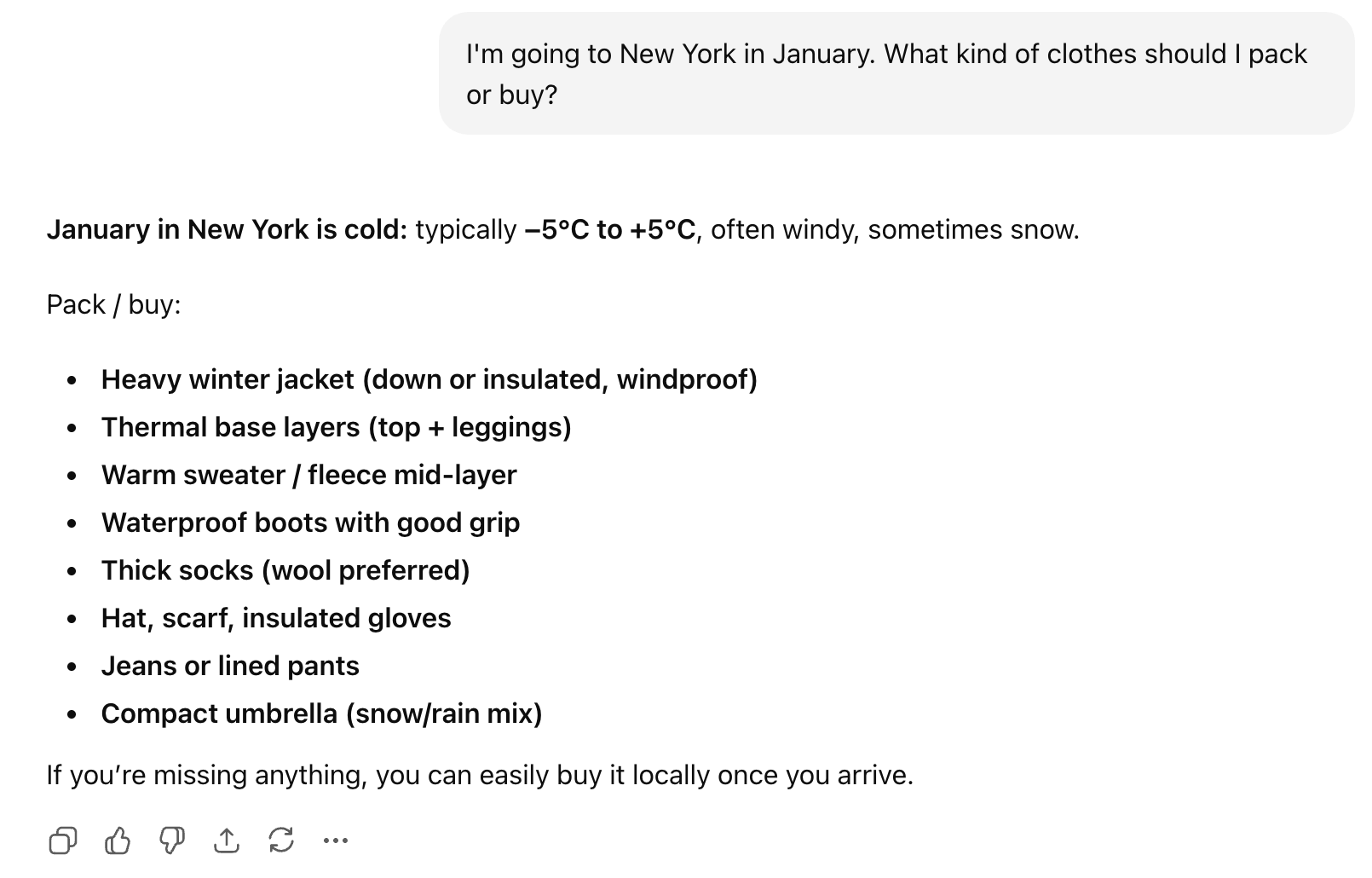
In traditional search, this person would need to already know enough to construct a useful query. They'd search "winter clothes New York" or "what to wear January NYC" and get back a mix of packing lists, fashion blogs, and retail landing pages. The quality of results depended heavily on how well they guessed the right keywords.
Conversational search inverts this requirement. The user states their actual situation - context, constraints, and all. And the system figures out what information they need.
Behind that single question, the AI runs multiple parallel processes: checking New York weather patterns for January (average highs around 40F, lows in the high 20s, significant wind chill), identifying typical activities (walking, subway, indoor venues), determining relevant clothing categories (outerwear, layers, footwear, accessories), and synthesizing practical recommendations from travel guides, fashion content, and cold-weather expertise.
What emerges isn't a list of products or even a list of links. It's a framework for thinking about the problem. The user learns they need layering for temperature regulation, wind-resistant outer shells, waterproof or water-resistant footwear, and accessories for exposed extremities. Categories surface organically from the explanation of why each matters.
This synthesis used to require the user to do the work. They'd read multiple articles, extract relevant information, and construct their own mental model of what they needed. Now that cognitive labor is outsourced. The research phase that might have taken multiple sessions across multiple days now completes in seconds.
The top of the funnel has moved. Problem-definition content that helps AI systems understand what people in various situations actually need has become a new category of valuable content. If your brand isn't present in the expert sources AI synthesizes at this stage, you don't exist yet in the buyer's journey. You're not competing. You're invisible.
Stage Two: Education Before Evaluation

Here's where traditional search forced users to become amateur experts before they could shop effectively.
To search for winter jackets, you needed to know terms like "down fill power," "synthetic insulation," "shell fabric," "DWR coating," and "temperature rating." You couldn't effectively compare products without first learning the vocabulary and frameworks experts use. This created a barrier that many buyers never fully crossed. They'd make decisions based on incomplete understanding, relying on price, brand recognition, or surface features.
Conversational search inverts this dynamic. The user asks in plain language what they need. The AI translates their practical situation into the technical requirements, then translates those requirements back into plain-language guidance.
The internal query expansion might explore: insulation types and their trade-offs (down vs. synthetic), temperature rating systems, water resistance standards (DWR treatment vs. waterproof membranes), mobility considerations for different coat lengths, layering compatibility, and urban vs. outdoor use cases.
But the response distills this technical landscape into practical guidance: "For New York winter, look for a jacket with synthetic or down insulation rated for at least 20F, a wind-resistant shell with water-repellent treatment, and a length that covers your hips for warmth while allowing mobility on stairs and subways."
The user isn't just learning about products, they're building purchasing criteria. They now understand what attributes matter, why those attributes matter, and what trade-offs they're navigating. This framework becomes the filter they'll use to evaluate every specific option they encounter.
For marketers, this changes everything about content strategy. Educational content that helps people understand how to evaluate your category has become strategically valuable in a new way. Brands that contribute to AI's understanding of category fundamentals earn implicit authority. The brands that appear when AI explains "what to look for in a winter jacket" have already shaped the criteria by which they'll be evaluated. They've written the rubric for their own test.
Stage Three: The Consideration Set

This is the moment brand visibility becomes existential.
In traditional search, brand discovery was distributed across multiple touchpoints. Users might encounter your brand through search ads, organic results, comparison sites, reviews, social recommendations, or retail marketplaces. Each touchpoint was an opportunity for discovery. Even if you missed one, you might catch another.
In conversational search, the consideration set forms in a single response. The AI synthesizes information from editorial reviews, expert recommendations, user feedback, and brand content to produce a curated list of credible options.
The brands that appear here - Patagonia, Arc'teryx, The North Face, Columbia, arrive backed by the accumulated weight of expert mentions, consistent review sentiment, and authoritative content presence. We don't have perfect visibility into citation rates across AI systems, but the pattern is unmistakable: the same brands surface repeatedly, while others never appear at all. In our own testing across dozens of winter clothing queries, the top four outdoor brands appeared in roughly three-quarters of AI-generated consideration sets. Everyone else fought for scraps or got nothing.
The ordering and frequency of these mentions quietly but powerfully shapes user perception. Brands mentioned first or most often appear more authoritative. Brands discussed in detail seem more credible than those mentioned in passing. Brands absent from this response might as well not exist for this buyer.
The critical difference from traditional search: There's no second page of results to scroll. There's no next search to run. The user has received what feels like a complete, expert-curated answer. They have no reason to look further. If you're not in this response, you're not in the running.
Traditional SEO focused on ranking for keywords. The new imperative is presence in the synthesis of credible information. This requires consistent visibility across the authoritative sources AI systems consult, not just your own content, but expert reviews, editorial coverage, and user-generated content that AI recognizes as trustworthy. You can't optimize your way into a conversation you're not part of.
Stage Four: Comparison
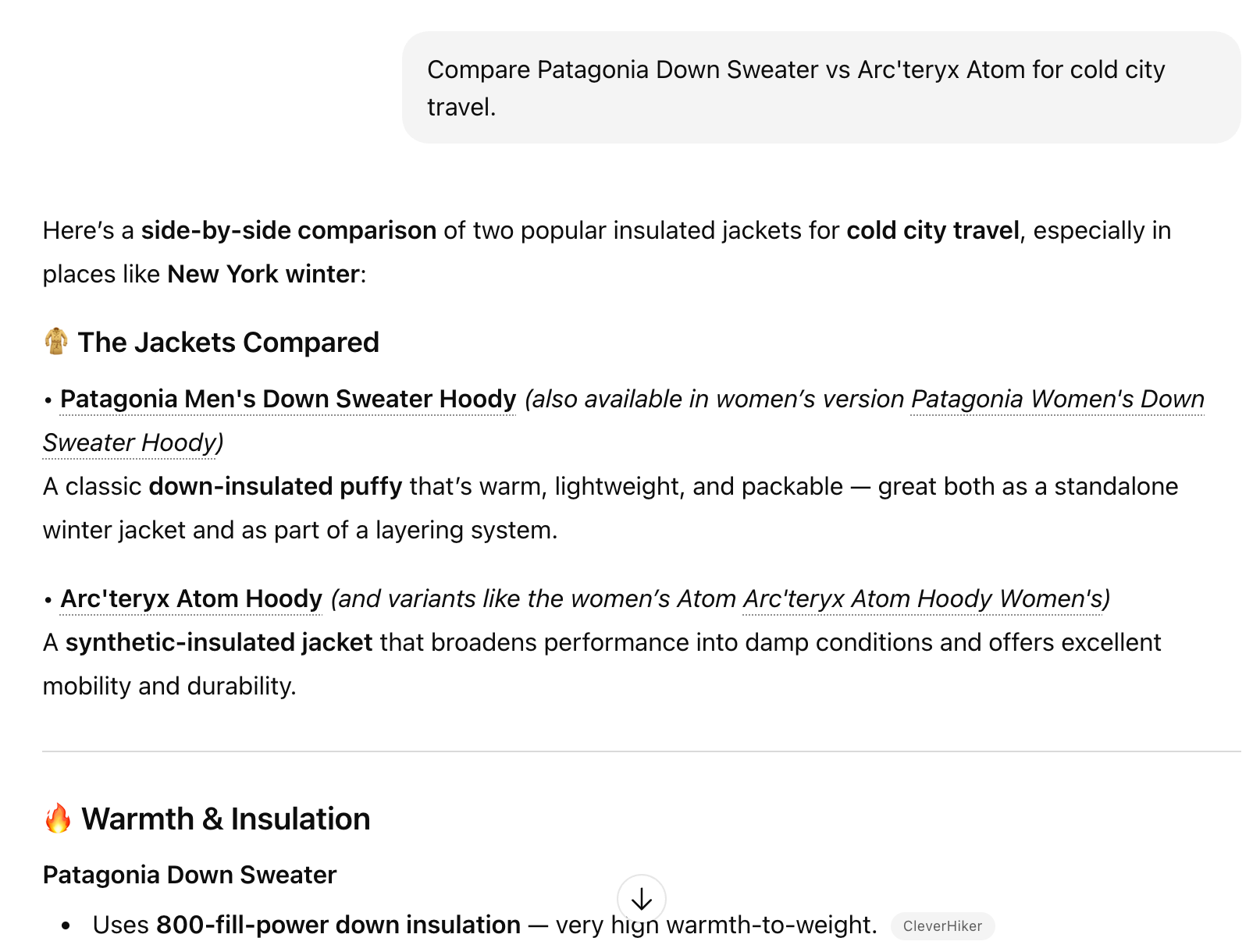
Product comparison used to be tedious, manual work.
You'd open multiple product pages, often in different tabs. You'd scan spec sheets looking for comparable numbers, but different brands used different terminology or rating systems. You'd search for reviews of each product separately, trying to extract comparative insights from content written about single products. You'd check prices across retailers. The cognitive overhead was substantial.
Conversational search collapses this work. The AI runs parallel queries across product specifications, expert reviews, user feedback, and retailer data, then synthesizes the results into a structured comparison.
The response might compare warmth-to-weight ratio, packability, durability track record, style versatility, and price. It translates technical differences into practical implications: "The Down Sweater provides slightly better warmth for weight, while the Atom offers superior breathability and moisture management if you'll be active."
Product links may appear as citations, representing the first potential exit point from the conversation. But many users continue asking questions rather than clicking out. They're gathering information, not yet ready to transact.
The implication is clear: specific, comparable product attributes matter more than ever. Vague marketing language ("incredibly warm," "superior quality") doesn't translate into comparison responses. Concrete specifications, third-party test results, and comparable metrics give AI systems material to work with. Products that can be clearly described outperform products that can only be vaguely praised. The brands that make themselves easy to compare accurately tend to compare favorably.
Stage Five: Trust Validation
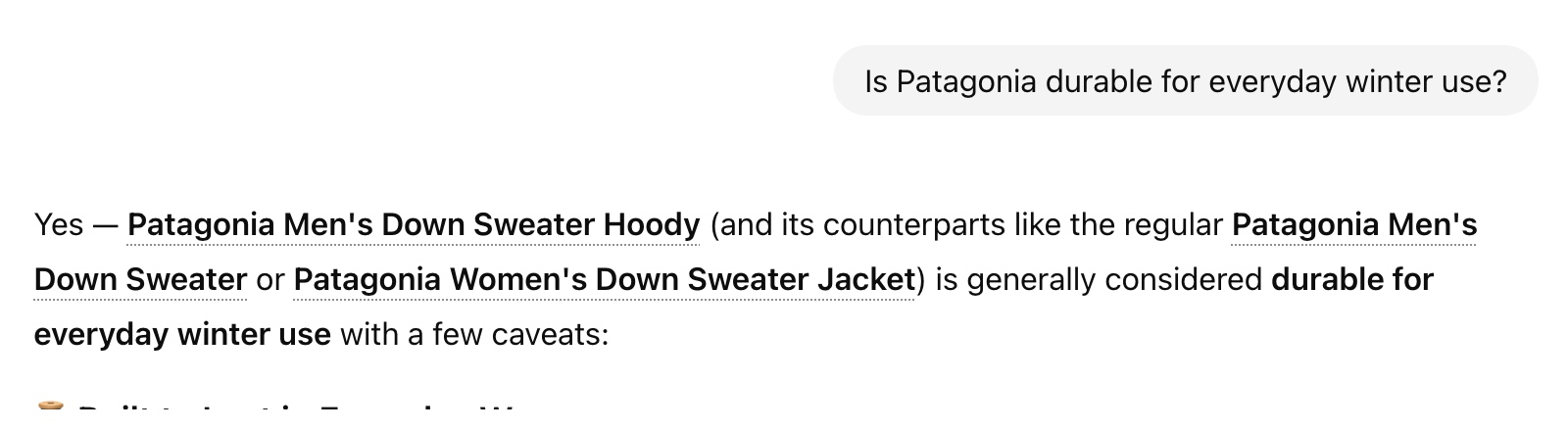
Trust-building used to be distributed across the consumer's research process.
They'd check product reviews on one site, look for long-term ownership experiences on Reddit or forums, visit the brand website for warranty information, maybe search for known issues or complaints. The user assembled a trust profile from disparate sources, weighted by their own judgment of each source's credibility.
Conversational search consolidates this work. The AI synthesizes reputation indicators, durability feedback, warranty details, customer service experiences, and brand values into a coherent trust assessment tailored to the user's specific question.
The response addresses the actual concern. Everyday durability, rather than providing generic brand information. It might reference the warranty policy (Patagonia's "Ironclad Guarantee"), summarize long-term ownership feedback, note any common wear points, and contextualize durability expectations for the product category.
This is where brand reputation compounds or collapses. Strong, consistent presence in expert content creates authority. Consistent positive feedback across sources builds confidence. Clear, verifiable claims about quality and warranty provide substance. Conversely, absence from authoritative sources creates doubt. Contradictory information raises concerns. Unrealistic marketing claims that conflict with user experiences don't just fail to persuade. They actively damage credibility when AI surfaces the contradiction.
Reputation management has become continuous, not reactive. The trust signals that AI systems synthesize exist across a landscape of content you may not control. Ensuring consistent, accurate, positive information requires attention to the full ecosystem, not just your owned properties, but anywhere people and experts discuss your brand. By the time you see a reputation problem in your conversion rates, the damage happened months ago in conversations you never witnessed.
Stage Six: The Transaction
The decision is made. Now the user exits to complete the purchase.
They might click a cited product link, navigate directly to the brand website, check Amazon for price and availability, or search by specific product name. The transaction itself still happens outside the conversational interface. For now.
But the user's mental state has fundamentally shifted from how they arrived at websites in the traditional model.
They're not coming to discover, research, or compare. The discovery happened in the conversation. The research is complete. The comparison is decided. They're arriving at your website to execute a purchase they've already validated through a process that may never have touched your properties.
This changes what your website needs to do. The traditional e-commerce site optimized for the full journey: category education, product comparison, trust-building, and conversion. When visitors arrive pre-decided, the conversion path needs to be frictionless. Additional "education" content can actually create confusion for someone who's already educated. Comparison tools become irrelevant for someone who's already compared.
Your website has shifted from being a discovery and education platform to being a transaction interface for pre-qualified buyers. The irony: you've been optimizing the wrong thing. All that investment in top-of-funnel content on your own site? It's now table stakes for the AI conversation happening elsewhere.
The Funnel Hasn't Disappeared. It's Collapsed Into a Conversation You Can't See.
Let's be precise about what's changing and what isn't.
The psychological stages of buying remain constant. People still move from vague awareness of a need, through education about options, to consideration of specific alternatives, to validation of their choice, to transaction. That sequence reflects how human decision-making works, and no interface change alters human psychology.
What's changed is where those stages happen and who orchestrates them.
In the traditional model, brands competed for attention at each stage. You ran awareness campaigns to surface during problem recognition. You created educational content to capture people researching solutions. You optimized product pages for comparison shoppers. You cultivated reviews and testimonials for the validation phase. Each stage happened on properties you could see, measure, and influence.
In the conversational model, stages one through five increasingly happen in a single AI interface. The user doesn't orchestrate their research across multiple sources. The AI does it for them, synthesizing information from across the web into coherent answers. By the time a potential customer reaches your website, they've already completed their research, formed their consideration set, evaluated alternatives, and decided you're the answer.
The traffic is higher intent. But it's also narrower. And the entire upstream journey that qualified that visitor happened somewhere you can't see and may not be influencing.
The Metrics Gap
This journey reveals why traditional marketing measurement increasingly feels incomplete.
Consider what happened in our example. A user went from "what should I pack for New York" to "I want to buy a Patagonia Down Sweater" through six prompts in a single conversation. That entire decision-making process which might have previously generated dozens of measurable touchpoints across multiple properties, happened in a closed system that produces no measurable signal until the user clicks out.
What you can't measure:
- Whether your brand appeared in the consideration set
- How your brand was described relative to competitors
- Whether trust validation went well or poorly
- What criteria the user applied to their decision
- How the AI characterized your products
What you can measure:
- That someone arrived at your site
- That they converted (or didn't)
The traditional attribution model assumed visibility at every stage - search impressions, ad exposures, site visits, page views, engagement metrics. Each touchpoint was measurable, and optimization happened at each step. When the research phase compresses into a single conversation elsewhere, those touchpoints vanish.
This isn't a technical problem waiting for better tracking. It's a structural shift in where decisions happen. The research phase has moved to a context you can't instrument. Your analytics dashboard shows you the end of a story that started somewhere you'll never see.